










Plant-Insect Ecosystems
Student Competition 10-Minute Paper
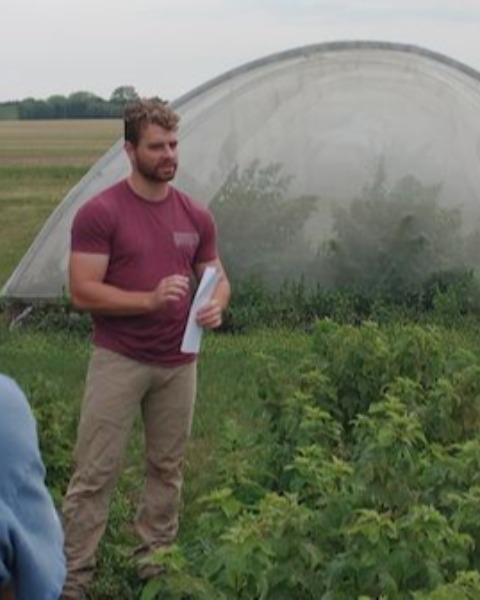
Adam G. Toninato
Adam Toninato
University of Minnesota
Shoreview, Minnesota
William D. Hutchison
University of Minnesota
Shoreview, Minnesota
Eric C. Burkness
University of Minnesota
Saint Paul, Minnesota
The Japanese beetle (JB, Popillia japonica), an invasive species from northern Japan, was first detected in Minnesota in 1968. According to growers and the MN Dept. of Agric., population size and feeding damage has been an increasing concern since 2010. According to trap catch data from our lab at the University of Minnesota, JB populations in raspberry have the ability to increase by an order of magnitude within 7-10 days. Previous studies in Minnesota have confirmed that defoliation caused by JB feeding can reduce overall marketable yield in fall raspberries. The primary goal of this study was to develop and validate an efficient sequential sampling plan that would be statistically sound but also a practical tool for growers. We used Green’s sequential sampling method and Taylor’s Power Law (TPL) regression to develop an enumerative sequential sampling plan to estimate JB density per meter-row. We used JB population sample data, collected on ‘Heritage’ fall raspberry at the Rosemount Research and Outreach Center, UMN. Based on our data and TPL, we were able to characterize the spatial distribution of JB; we found the adults to be highly aggregated with the TPL slope ranging from b = 1.35 to 1.50. Using this information and the Resampling for Validation of Sampling Plans (RVSP) software, we validated the plan to verify an average precision level of 0.25 (SEM/mean) was maintained using an Average Sample Number (ASN) of 20, 1-m-row samples, a cost-effective sample size for growers.